
Malik was helping his uncle move when he found the photograph.
Tucked inside an old program book from 100 Black Men of Indianapolis was a Beautillion portrait from more than a decade ago. Young men in suits. Poised. Polished. Future-focused. And among them was his uncle, Jamal.
At the time, Malik didn't realize he was looking at a glimpse of his own future.
A few years later, as a sophomore in high school, Malik walked into his first session of The 100's Dollars & $ense Financial Literacy Program skeptical and unimpressed.
“At first, I was annoyed.”
He joined at his mother's encouragement, expecting long lectures and generic advice. Instead, he was immediately drawn in by the program's instructor, Dr. Matt Will, who led the curriculum in partnership with the University of Indianapolis.
“I was prepared for a lecture, so when Dr. Matt handed out packets, immediately diving into stocks, bonds, and ETFs, he captured my interest. We were told we'd be completing a final project with stock picks that we researched and had to defend, and I immediately felt a rush. I'd never had to defend a financial decision before.”
That first year shifted the way Malik thought about money. But more importantly, it changed the way he thought about himself.
So, when his mother asked if he wanted to return for a second year, there was no hesitation.
By then, Malik had kept every packet, every note, and every worksheet from the first program cycle. He walked into year two differently—more prepared, more curious, and more confident.
“I knew I wasn't going to get it right the first time. That's why I was eager to participate the second year. I had all the knowledge from year one and a better idea of what I'd try differently.”
That mindset is at the core of what The 100's financial literacy programming truly teaches. The language of investing is only the surface lesson. Underneath it is something bigger: the discipline to try, fail, reassess, and return stronger. To make decisions. To defend them. To learn without shame.
From Simulation to Real Account
And in year two, the stakes became more real. In addition to the 15-week Dollars & $ense program on Saturday mornings, students can participate in the Wells Fargo Junior Investment game, a two-month simulation in which they manage a hypothetical $100,000 portfolio under real market conditions. Malik selected his stocks, tracked market movements, and learned firsthand what volatility feels like.
“The financial literacy program teaches youth the logistics. The Wells Fargo program teaches them how to apply them.”
When the program ended, Malik did something many adults still haven't done: he opened his own investment account. Two months later, he was already seeing gains.
A Family Commitment to Life Skills
For his parents, that moment represented far more than a financial milestone.
“Neither Malik's mother nor I learned financial literacy in our youth. That's something we actually needed before we went to college, which is why we were so motivated to ensure Malik had a different experience.”
When Malik started earning money through popcorn sales, milestone awards, and opportunities he had worked hard to earn, his parents made a deliberate decision. They weren't going to simply save or invest the money for him. They wanted him to understand it. To make decisions with it. To learn how to grow it himself.
For Malik's parents, the value of the program was never just about stocks, portfolios, or financial terminology. It was about exposure. Accountability. Confidence. It was about placing their son in rooms with accomplished Black men who would challenge him to think bigger about his future.
“I wanted to make sure he was surrounded by as many positive Black men as I could. Men who could really open his eyes and influence him on his journey.”
The Confidence Beneath the Accomplishments
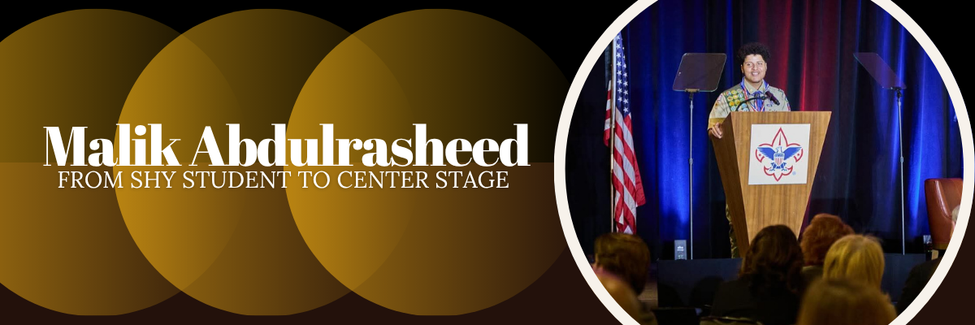
On paper, Malik already looks exceptional. He is an Eagle Scout who has earned 118 merit badges in a program where only 21 are required. He has spoken at the Governor's Scout Breakfast and received a standing ovation twice. He has addressed audiences of more than 1,000 people, sharing stages with former Governor Eric Holcomb and Governor Mike Braun. He is also a published author, documenting his journey from Cub Scout to Eagle Scout in a children's book now available on Amazon.
As a Cub Scout, Malik raised more than $60,000 in popcorn sales over four years—funding opportunities for inner-city youth in his troop who otherwise could not afford to attend camp.
By every external measure, Malik was already succeeding. And yet, according to his mother, there was still something underneath all of those accomplishments.
“He would still get nervous and shy about certain things. We were searching for opportunities to help him build his confidence as a young man, a public speaker, and a community leader.”
That's what eventually led him into The 100's Developing Future Leaders program led by Anthony Murdock.
“It gave him the confidence he needed to apply everything he's ever learned. It reassures him that he's learned the right things and how to apply them.”
The 100 didn't teach Malik how to speak in front of people. He already knew how to do that. The 100 helped him believe he had something worth saying. That is a different kind of mentorship altogether.
The Doors Already Opening
Malik is only seventeen years old, but his future is already unfolding in real time. This summer alone, he has received three job offers, including a paid engineering internship that came through a connection within 100 Black Men of Indianapolis. He now teaches financial literacy concepts he learned through Dollars & $ense to younger members of his Boy Scout troop, and in May, he will help lead the Indianapolis 500 Parade.
Long-term, he plans to pursue engineering, a path shaped by years of curiosity, from building Legos as a child to teaching himself programming by taking apart and rebuilding electronics.
“They have these programs, and while they're fantastic, there are also small interactions, personal conversations, and real relationships that make this experience so impactful for young men.”
Somewhere more than a decade ago, Malik's uncle Jamal stood in a suit for a Beautillion portrait without knowing that years later, another young man in his family would walk through the same doors—and find a community ready to pour into him, too.
Continue Reading
More stories from The 100 →